




MAGMA Convening Highlights The Michigan Maritime and Shipbuilding Workforce Opportunities
The Michigan Alliance for Greater Mobility Advancement (MAGMA), convened by the Workforce Intelligence Network (WIN), brought together leaders from industry, education, workforce development, and government on September 11, 2026, at Macomb Community College to explore the resurgence of the American maritime industry and the opportunities it presents for Michigan.
The MAGMA Advisory Council meeting featured insights from:
- Matthew Collette, Professor of Naval Architecture and Marine Engineering, University of Michigan
- Christopher “Chris” Reilly, Director of Workforce and Continuing Education for Engineering and Advanced Technology, Macomb Community College
- Rey Guzman, Talent Development Liaison for Industry Engagement and Sector Strategies, Michigan Department of Labor and Economic Opportunity
- Amy Kraatz, Talent Development Liaison for Industry Engagement and Sector Strategies, Michigan Department of Labor and Economic Opportunity
- Jeran Culina, Senior Manager of Business Leaders United at National Skills Coalition and panel moderator
- Ben Cruz, Macomb Community College, who provided the meeting’s welcome and closing remarks
- And an Underwater Remotely Operated Vehicle Project Display with Barb Land & Michelle Zemke from Square One Education Network
The Shipbuilding Awakening
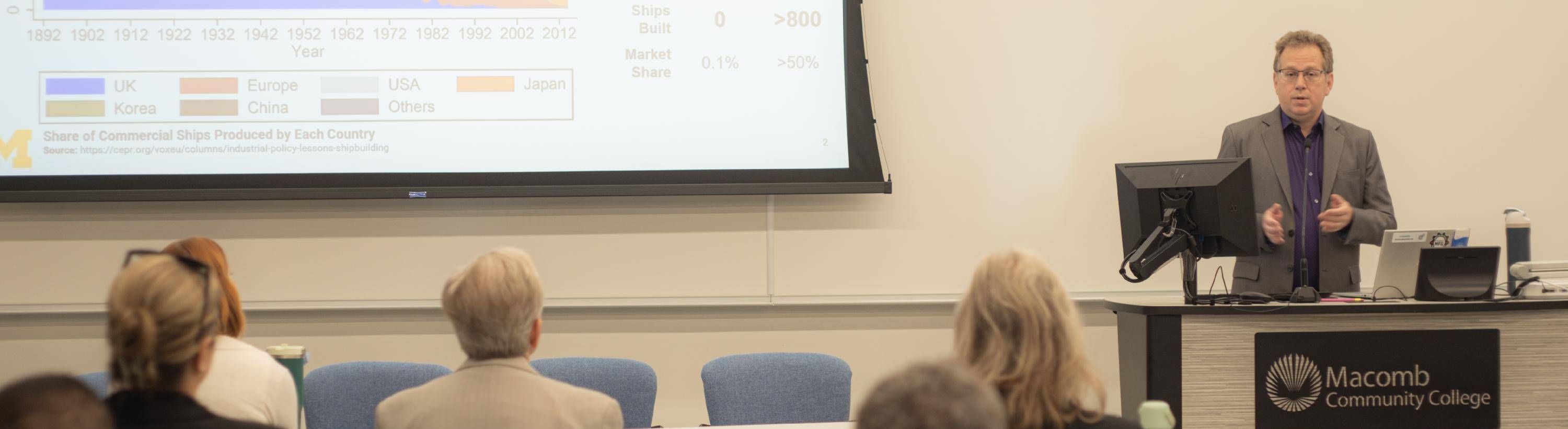
During the keynote presentation, The Maritime Future and Michigan, Collette outlined the urgent need to rebuild the nation’s shipbuilding capacity. China constructed more than 800 ships in 2024 and now controls more than half of the global commercial shipbuilding market, compared with a U.S. market share of approximately 0.1%.
Bipartisan federal action and significant new investments are creating momentum for a domestic maritime resurgence. However, meeting the nation’s shipbuilding goals will require more than new shipyards. Approximately 70% to 80% of a ship’s value comes from its supply chain, creating opportunities for manufacturers, technology companies, educational institutions, and workforce organizations throughout Michigan.
Workforce development will be essential to this expansion. Shipbuilders and suppliers are projected to need approximately 250,000 skilled workers over the next decade, in addition to thousands of jobs connected to commercial shipbuilding and the broader maritime supply chain.
Michigan’s Great Lakes Advantage
Michigan is uniquely positioned to contribute to the nation’s maritime resurgence through its network of universities, community colleges, ports, skilled trades, manufacturers, defense partners, and advanced technology organizations. The state can also draw upon its automotive, mobility, and advanced manufacturing expertise to support emerging maritime markets.
Michigan’s first statewide maritime strategy identifies six priority areas:
- Modernize port and intermodal infrastructure
- Grow Michigan’s maritime manufacturing economy
- Accelerate the adoption of advanced vessel technologies and fuels
- Lead the nation in maritime workforce recruitment, training, and retention
- Cultivate a thriving maritime innovation ecosystem
- Strengthen the sustainability, resilience, and revitalization of recreational harbors, marinas, and boating access sites
Michigan’s 33 active ports handle more than 50 million tons of cargo, contribute more than $3 billion to the state’s economy, and support more than 17,000 jobs. The Great Lakes maritime system also plays an important role in a binational economy that supports approximately 350,000 shipping-related jobs across the United States and Canada.
Preparing Michigan’s Maritime Workforce
A fireside chat and panel discussion examined the programs and partnerships already helping Michigan prepare workers for maritime and shipbuilding careers.
The $50 million Michigan Maritime Manufacturing Initiative, or M3 Initiative, supports the state’s maritime defense workforce by focusing on high-demand submarine production skills, including welding and CNC machining. The initiative brings community colleges together with K-12 outreach programs, veteran recruitment efforts, and industry partners.
Macomb Community College is supporting this work through a newly funded $15.4 million maritime training center. The college has already graduated 162 students through its first seven cohorts, including 88 CNC machinists and 74 welders.
The Michigan Industry-Driven Skills Training Program (MIDSTP) builds upon the success of the M3 Initiative. Supported by an $8 million U.S. Department of Labor Industry-Driven Skills Training Fund award and a $3.6 million state investment, the program will prepare up to 720 workers for high-demand shipbuilding occupations, including welding, marine electrical systems, advanced manufacturing, and other skilled trades.
Additional investments will help community colleges purchase equipment, expand instructional capacity, recruit and train faculty, retrofit laboratories, and strengthen career pathways into high-skill, high-wage maritime occupations.
The meeting underscored that Michigan has the industrial capabilities, educational assets, and collaborative partnerships needed to support America’s maritime future. By aligning investment, innovation, and workforce development, Michigan can help strengthen national defense, expand domestic manufacturing, and create new career opportunities for workers across the state.
CLICK HERE TO VIEW & DOWNLOAD THE SLIDE DECK.Learn more about MAGMA and future Advisory Council meetings at MiAutomobility.org.
.jpg?t=202609151844000)
Content was generated by AI and reviewed by WIN staff.
 Twitter